Dear Dokken,
Thank you dor your quick response, please find the schematic of the problem below;
I would like to solve:
\frac{\partial \phi_1}{\partial t} = D_1\nabla \cdot \nabla \phi_1 \quad \text{in $\Omega_1$},
and
\frac{\partial \phi_2}{\partial t} = D_2\nabla \cdot \nabla \phi_2 + s\phi_2 (1-\phi_2/\phi_0) \quad \text{in $\Omega_2$},
at the same time. Both domains have symmetry (Neumann) BC on the left. Blue domain has a BC of \phi_2(right, t)=1.0 on the right end and zero elsewhere. As time progress, blue domain fills up with 1.0s and the cells in \Omega_2 with value 1.0 should become Neumann BC for \Omega_1.
What I made so far is to manually shrink the blue domain, as 2D MWE for full domain shows below:
from dolfinx.fem import functionspace, Constant, Function, form, assemble_matrix
from dolfinx.fem.petsc import assemble_matrix, apply_lifting, set_bc, assemble_vector, create_vector
from petsc4py import PETSc
from dolfinx.io.gmshio import model_to_mesh
from mpi4py import MPI
from dolfinx import default_scalar_type
from ufl import TrialFunction, TestFunction, Measure, dot, grad
from dolfinx.io import XDMFFile
from dolfinx import fem
import numpy as np
import sys
import os
import gmsh

projectRoot = os.path.join(os.getcwd())
resultsDir = os.path.join(projectRoot,'ResultsDir')
screenshotsDir = os.path.join(resultsDir,'screenshots')
test_name = "transient_2d.xdmf"
xdmf_filename = "/"+test_name

def twoDimHydro(lx, ly, l_drug, drug_start_x, lc=0.005):
    path = os.path.dirname(os.path.abspath(__file__))
    mesh_dir = "/MeshDir"
    mesh_name = "/twodim"

    gmsh.initialize()
    gmsh.option.setNumber("General.Terminal", 0)
    gmsh.model.add(__name__)

    '''
             p_drug_start    p_drug_end
    1-------------|--------------|-------------------2
    |     l1           l_drug          l_2          |
    |                                               |
    |                                               |
    | l_4                                           | l_3
    |                                               |
    |-----------------------------------------------|
    4                   l_wound                      3
    '''

    p_1 = gmsh.model.occ.addPoint(0, ly, 0)
    p_2 = gmsh.model.occ.addPoint(lx, ly, 0)
    p_drug_start = gmsh.model.occ.addPoint(drug_start_x, ly, 0)
    p_drug_end =   gmsh.model.occ.addPoint(drug_start_x+l_drug, ly, 0)
    p_3 = gmsh.model.occ.addPoint(lx, 0, 0, lc/5)
    p_4 = gmsh.model.occ.addPoint(0, 0, 0, lc/5)

    l_1 = gmsh.model.occ.addLine(p_1, p_drug_start)
    l_drug = gmsh.model.occ.addLine(p_drug_start, p_drug_end)
    l_2 = gmsh.model.occ.addLine(p_drug_end, p_2)
    l_3 = gmsh.model.occ.addLine(p_2, p_3)
    l_wound = gmsh.model.occ.addLine(p_3, p_4)
    l_4 = gmsh.model.occ.addLine(p_4, p_1)

    cl_1 = gmsh.model.occ.addCurveLoop([l_1,l_drug,l_2, l_3, l_wound, l_4])
    s_1 = gmsh.model.occ.addPlaneSurface([cl_1])

    gmsh.model.occ.synchronize()

    gmsh.model.addPhysicalGroup(1, [l_1,l_2,l_3,l_4], tag=1)  # all other tag
    gmsh.model.addPhysicalGroup(1, [l_drug], tag=2)  # drug tag
    gmsh.model.addPhysicalGroup(1, [l_wound], tag=3)  # wound tag
    gmsh.model.addPhysicalGroup(2, [1], tag=1)  # hydrogel tag

    gmsh.option.setNumber("Mesh.MeshSizeMax", lc)
    gmsh.option.setNumber("Mesh.Optimize", 1)

    gmsh.model.mesh.generate(2)

    if "-nopopup" not in sys.argv:
        gmsh.fltk.run()

    return gmsh.model

lx=1
ly=1/2
l_drug=0.05
drug_start_x=lx/2-l_drug/2

gmsh_model = twoDimHydro(lx, ly, l_drug, drug_start_x, lc=0.01)

mesh, subdomains, facet_tags = model_to_mesh(gmsh_model, MPI.COMM_WORLD, rank=0, gdim=2)

drug_concentration = +1.0
wound_concentration = 0.5
other_concentration = 0.0
other_flux = 0.0

degree = 1

V = functionspace(mesh, ("Lagrange", degree))
u = TrialFunction(V)

# Static/tagged BCs (use your existing tags 1 and 2)
u_other = Function(V)
u_other.x.array[:] = other_concentration
u_drug = Function(V)
u_drug.x.array[:] = drug_concentration

bc_other = fem.dirichletbc(
    u_other,
    fem.locate_dofs_topological(V, mesh.topology.dim-1, facet_tags.find(1))
)
bc_drug = fem.dirichletbc(
    u_drug,
    fem.locate_dofs_topological(V, mesh.topology.dim-1, facet_tags.find(2))
)

def build_wound_bc(V, l_wound, value, lx, x_center=None, y_bottom=0.0, atol=1e-12):
    """
    Return a Dirichlet BC for the wound that shrinks symmetrically toward the middle.

    Args:
        V: Function space.
        l_wound: Remaining wound length along the bottom edge.
        value: Dirichlet value to impose on the wound segment.
        lx: Total domain width in x.
        x_center: Center of the wound segment (defaults to lx/2).
        y_bottom: y-coordinate of the bottom boundary.
        atol: tolerance for y≈y_bottom check.

    Behavior:
        - If l_wound <= 0 -> returns None (no wound left).
        - If l_wound > lx -> clamps to lx.
        - Selects bottom boundary dofs with x in [x_left, x_right], where
          x_left = x_center - l_wound/2 and x_right = x_center + l_wound/2.
    """
    if x_center is None:
        x_center = 0.5 * lx

    # Clamp length and short-circuit if nothing left
    L = float(np.clip(l_wound, 0.0, lx))
    if L <= 0.0:
        return None

    x_left  = x_center - 0.5 * L
    x_right = x_center + 0.5 * L

    # Pick boundary dofs on bottom (y≈y_bottom) & within [x_left, x_right]
    def on_wound(x):
        y_ok = np.isclose(x[1], y_bottom, atol=atol)
        x_ok = np.logical_and(x[0] >= x_left, x[0] <= x_right)
        return np.logical_and(y_ok, x_ok)

    dofs = fem.locate_dofs_geometrical(V, on_wound)
    if dofs.size == 0:
        return None  # no wound region (e.g., very small L wrt mesh)

    # Constant Dirichlet value (fast + robust):
    return fem.dirichletbc(PETSc.ScalarType(value), dofs, V)

l_wound = lx

bc_wound = build_wound_bc(V, l_wound, wound_concentration, lx)

xdmf = XDMFFile(V.mesh.comm, resultsDir+xdmf_filename, "w")
xdmf.write_mesh(V.mesh)

# Define initial condition
u_n = Function(V)
u_n.x.array[:] = 0.5
u_n.name = "u_n"

# Define temporal parameters
t = 0  # Start time
T = 1200  # Final time
num_steps = int(T/2)
dt = T / num_steps  # time step size

D = default_scalar_type(2.6e-5)

u, v = TrialFunction(V), TestFunction(V)
dx = Measure("dx", domain=V.mesh, subdomain_data=subdomains)
uh = Function(V)
uh.name = "phi"
uh.interpolate(u_n)

xdmf.write_function(uh, t)

dt = T / num_steps  # time step size

f = Constant(V.mesh, PETSc.ScalarType(0))

a = u * v * dx + dt * D * dot(grad(u), grad(v)) * dx
L = (u_n + dt * f) * v * dx

bcs = [bc_other, bc_drug] + ([bc_wound] if bc_wound is not None else [])

bilinear_form = form(a)
linear_form = form(L)

A = assemble_matrix(bilinear_form, bcs=bcs)
A.assemble()
b = create_vector(linear_form)

# Solve
print("\n- Transient problem is assembled.")
print("\n- Starting the solution..")

solver = PETSc.KSP().create(V.mesh.comm)
solver.setOperators(A)
solver.setType(PETSc.KSP.Type.PREONLY)
solver.getPC().setType(PETSc.PC.Type.LU)

for i in range(num_steps):
    t += dt

    # Update the right hand side reusing the initial vector
    with b.localForm() as loc_b:
        loc_b.set(0)
    assemble_vector(b, linear_form)

    # e.g., shrink every 30 steps (just an example):
    if (i+1) % 1 == 0:
        l_wound = max(0.0, l_wound - 0.01/6)
        bc_wound = build_wound_bc(V, l_wound, wound_concentration, lx)

    # Build list of BCs for this step
    bcs = [bc_other, bc_drug] + ([bc_wound] if bc_wound is not None else [])

    # Apply Dirichlet boundary condition to the vector
    apply_lifting(b, [bilinear_form], [bcs])
    b.ghostUpdate(addv=PETSc.InsertMode.ADD_VALUES, mode=PETSc.ScatterMode.REVERSE)
    set_bc(b, bcs)

    # Solve linear problem
    solver.solve(b, uh.x.petsc_vec)
    uh.x.scatter_forward()

    print("Iteration: ", i, "Time:", t)

    # Update solution at previous time step (u_n)
    u_n.x.array[:] = uh.x.array

    # Write solution to file
    xdmf.write_function(uh, t)

xdmf.close()

solution = uh
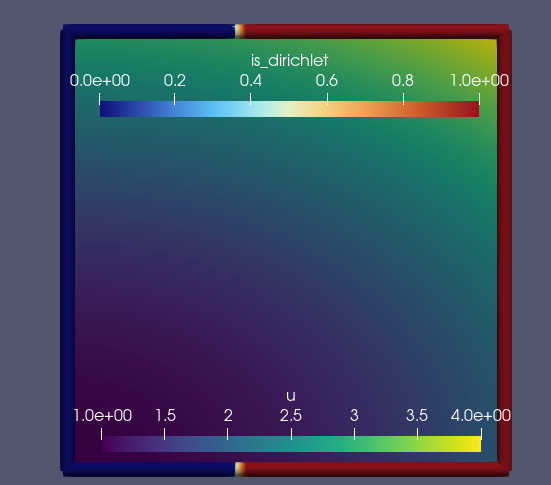
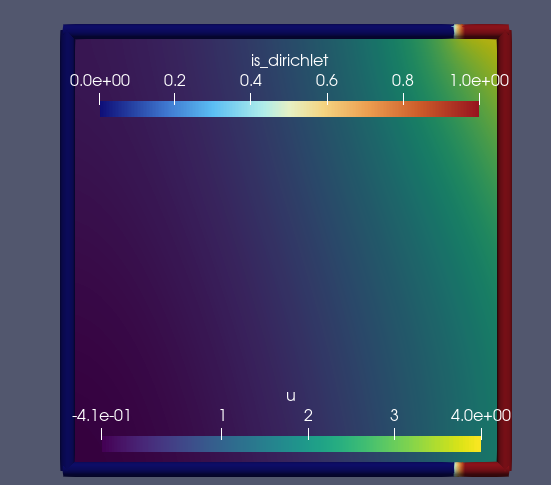
gives;
at t=32 and
at t=340 and
at the end, t=1200.
What I want is to do that shrinking with the solution of 1D diffusion.
What would you recommend me to handle this?