Hey everyone
I’m attempting to model an electric machine for now in magnetostatic 2D.
I’m using dolfinx 0.9.0 on WSL 2.
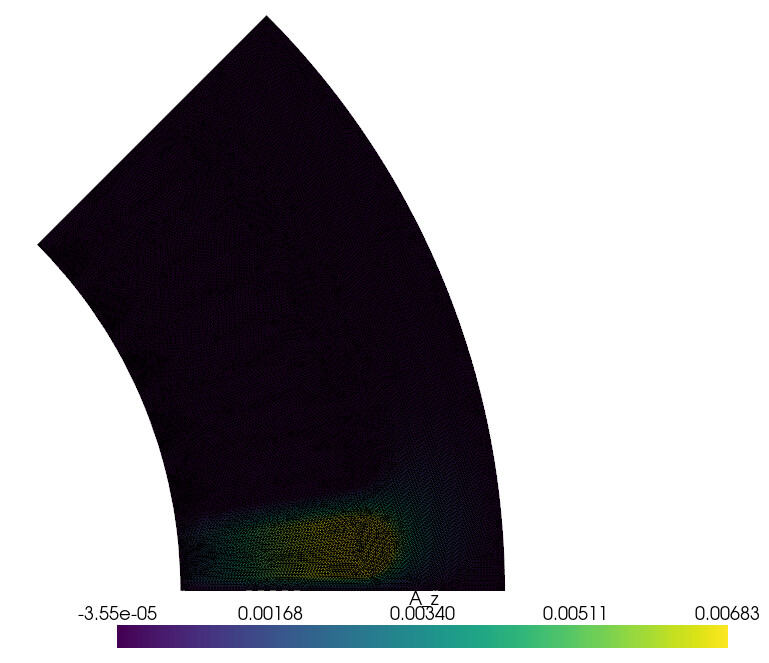
I’m running into an issue where if I excite PhaseA1, the magnetic vector potential is extremely high and not originating form the PhaseA1 surface. If, however, I ignore PhaseA1 and excite any other face, PhaseA2 for example. I do get the result I expect.
A MWE is:
from math import pi

import numpy as np
import pyvista
import ufl
from basix.ufl import element
from dolfinx import default_scalar_type
from dolfinx.fem import functionspace, Constant, Function, form, assemble_scalar, locate_dofs_topological, dirichletbc
from dolfinx.fem.petsc import LinearProblem
from dolfinx.io.gmshio import read_from_msh
from dolfinx.mesh import locate_entities_boundary
from dolfinx.plot import vtk_mesh
from mpi4py.MPI import COMM_WORLD
from ufl import Measure, TrialFunction, TestFunction, inner, grad, as_ufl

class Config:
    excitation = {
        "current": 250.0,
        "current_offset": 0.0,
        "turns": 9,
    }
geometry = {'Bounds': 15, 'Center': {'center': 1},
            'Duct': {'geom': {'curve': [101, 102, 103, 104, 105, 106, 107, 108, 109], 'curve_loop': 22, 'name': 'Duct', 'point': [103, 104, 105, 106, 107, 108, 109, 110, 111], 'surface': [17, 18, 19, 20], 'tag': 10}, 'material': {'mu_0': 4*pi * 1e-7, 'mu_r': 1.0}},
            'Lower_band': {'geom': {'curve': [158, 159, 160, 161], 'curve_loop': 44, 'name': 'AirGap_LowerBand', 'point': [140, 142, 144, 146], 'surface': [33], 'tag': 13}, 'material': {'mu_0': 4*pi * 1e-7, 'mu_r': 1.0}},
            'Magnet1': {'geom': {'curve': [93, 94, 95, 96], 'curve_loop': 20, 'name': 'Magnet1', 'point': [95, 96, 97, 98], 'surface': [14], 'tag': 11}, 'material': {'mu_0': 4*pi * 1e-7, 'mu_r': 1.03}},
            'Magnet2': {'geom': {'name': 'Magnet2', 'surface': [15], 'tag': 12}, 'material': {'mu_0': 4*pi * 1e-7, 'mu_r': 1.03}},
            'PhaseA1': {'geom': {'curve': [1, 2, 3, 4], 'curve_loop': 1, 'name': 'PhaseA1', 'point': [2, 3, 4, 5], 'surface': [1], 'tag': 4}, 'material': {'mu_0': 4*pi * 1e-7, 'mu_r': 1.0}},
            'PhaseA2': {'geom': {'name': 'PhaseA2', 'surface': [2], 'tag': 5}, 'material': {'mu_0': 4*pi * 1e-7, 'mu_r': 1.0}},
            'PhaseB1': {'geom': {'name': 'PhaseB1', 'surface': [5], 'tag': 6}, 'material': {'mu_0': 4*pi * 1e-7, 'mu_r': 1.0}},
            'PhaseB2': {'geom': {'name': 'PhaseB2', 'surface': [6], 'tag': 7}, 'material': {'mu_0': 4*pi * 1e-7, 'mu_r': 1.0}},
            'PhaseC1': {'geom': {'name': 'PhaseC1', 'surface': [3], 'tag': 8}, 'material': {'mu_0': 4*pi * 1e-7, 'mu_r': 1.0}},
            'PhaseC2': {'geom': {'name': 'PhaseC2', 'surface': [4], 'tag': 9}, 'material': {'mu_0': 4*pi * 1e-7, 'mu_r': 1.0}},
            'Rotor': {'geom': {'curve': [143, 144, 145, 146], 'curve_loop': 37, 'name': 'Rotor', 'point': [134, 135, 136, 137], 'surface': [32], 'tag': 2}, 'material': {'mu_0': 4*pi * 1e-7, 'mu_r': 1000}},
            'Slot': {'geom': {'curve': [25, 26, 27, 28, 29, 30, 31, 32], 'curve_loop': 7, 'name': 'Slot', 'point': [26, 27, 28, 29, 30, 31, 32, 33, 34], 'surface': [8, 9, 10, 11, 12, 13], 'tag': 3}, 'material': {'mu_0': 4*pi * 1e-7, 'mu_r': 1.0}},
            'Stator': {'geom': {'curve': [132, 133, 134, 135], 'curve_loop': 29, 'name': 'Stator', 'point': [130, 131, 132, 133], 'surface': [22], 'tag': 1}, 'material': {'mu_0': 4*pi * 1e-7, 'mu_r': 1000}},
            'Upper_band': {'geom': {'curve': [162, 163, 164, 165], 'curve_loop': 45, 'name': 'AirGap_UpperBand', 'point': [141, 143, 145, 147], 'surface': [34], 'tag': 14}, 'material': {'mu_0': 4*pi * 1e-7, 'mu_r': 1.0}}}

mesh, cell_tags, facet_tags = read_from_msh("geometry.msh", comm=COMM_WORLD, rank=0, gdim=2)
mesh.topology.create_connectivity(2, 1)
mesh.topology.create_connectivity(1, 2)
mesh.topology.create_connectivity(2, 0)
mesh.topology.create_connectivity(0, 2)

dx = Measure("dx", subdomain_data=cell_tags, domain=mesh, metadata={"quadrature_degree": 2})

cell = mesh.ufl_cell().cellname()

# Define function space
CG_V = element("Lagrange", cell, 2, shape=())  # CG: Continuous Galerkin vector potential (Sized for Az only)
DG_0 = element("DG", cell, 0, shape=())  # DG: Discontinuous Galerkin scalar space

V = functionspace(mesh, CG_V)
V_DG = functionspace(mesh, DG_0)
space = {"VectorPotential": V,
         "DiscontinuousScalar": V_DG, }

u = TrialFunction(space["VectorPotential"])
v = TestFunction(space["VectorPotential"])
space["TrialFunction"] = {"VectorPotential": u}
space["TestFunction"] = {"VectorPotential": v}

I = Constant(mesh, Config.excitation["current"] * Config.excitation["turns"])

# Define weak form
nu = Function(space["DiscontinuousScalar"])
for key in geometry.keys():
    if key in ["Center", "Bounds"]:
        continue
    out = geometry[key]

    tag = out["geom"]["tag"]-1
    out["mu"] = 1.0 / (out["material"]["mu_0"] * out["material"]["mu_r"])

    cells = cell_tags.find(tag)
    nu.x.array[cells] = np.full_like(cells, out["mu"], dtype=default_scalar_type)

u = space["TrialFunction"]["VectorPotential"]  # Vector potential trial function
v = space["TestFunction"]["VectorPotential"]  # Vector potential test function

a = nu * inner(grad(u), grad(v)) * dx

# Get current excitation
phase_order = ["PhaseA1", "PhaseA2", "PhaseC1", "PhaseC2", "PhaseB1", "PhaseB2"]
phase_offset = [0.0, 0.0, 2 / 3 * pi, 2 / 3 * pi, -2 / 3 * pi, -2 / 3 * pi]
phase_dir = [1.0, 1.0, -1.0, -1.0, 1.0, 1.0]  # Direction of current for each phase

current = []
source_terms = []
v = space["TestFunction"]["VectorPotential"]

for i, phase in enumerate(phase_order):
    geom = geometry[phase]["geom"]

    coil_I = as_ufl(default_scalar_type(phase_dir[i]) * I)  # [A] Current magnitude
    pos = as_ufl(default_scalar_type(0))  # [rad] Position of the rotor at the current timestamp
    coil_current = coil_I * ufl.cos(pos + phase_offset[i])

    cells = cell_tags.find(geom["tag"]-1)
    Jz = Function(space["DiscontinuousScalar"])
    Jz.x.array[:] = 0
    Jz.x.array[cells] = coil_current / assemble_scalar(form(1 * dx(geom["tag"]-1)))
    Jz.x.scatter_forward()

    from dolfinx import plot
    import pyvista
    from pyvista import UnstructuredGrid

    plotter = pyvista.Plotter(window_size=(500, 500))
    topology, cells, x = plot.vtk_mesh(mesh, mesh.topology.dim)
    grid = UnstructuredGrid(topology, cells, x)
    Jz_val = Jz.x.array
    grid.cell_data["Jz"] = Jz_val
    plotter.add_mesh(grid, scalars="Jz", show_edges=True, cmap="coolwarm")
    plotter.view_xy()
    plotter.show()

    L = Jz * v * dx
    source_terms.append(L)

L = sum(source_terms)

# Boundary conditions
tdim = mesh.topology.dim - 1
facets = locate_entities_boundary(mesh, tdim, lambda x: np.full(x.shape[1], True))
dofs = locate_dofs_topological(V, tdim, facets)
bc = dirichletbc(default_scalar_type(0), dofs, V)
bcs = [bc]

Az = Function(space["VectorPotential"])

problem = LinearProblem(a,
                        L,
                        u=Az,
                        bcs=bcs,
                        petsc_options={"ksp_type": "preonly",
                                       "pc_type": "lu",
                                       "pc_factor_mat_solver_type": "mumps",
                                       "ksp_error_if_not_converged": True}
                        )
problem.solve()

plotter = pyvista.Plotter()
Az_grid = pyvista.UnstructuredGrid(*vtk_mesh(space["VectorPotential"]))
Az_grid.point_data["A_z"] = Az.x.array
Az_grid.set_active_scalars("A_z")
warp = Az_grid.warp_by_scalar("A_z", factor=1e-10)
actor = plotter.add_mesh(warp, show_edges=True)

plotter.view_xy()
plotter.show()
With the mesh generated by:
from dataclasses import dataclass

from math import pi, radians, cos, sin, tan, ceil

import gmsh
from sympy import symbols, Eq, solve

mm = 1e-3  # [m] millimeter to meter conversion factor

@dataclass
class MachineDims:
    dimension: int = 2                    # [int] Dimension of the geometry, 2D or 3D
    periodicity: int = 8
    geom_start_angle: float = 0.0         # [rad] Start angle of the geometry
    geom_end_angle: float = 1/periodicity * 2 * pi  # [rad] end angle of the geometry in radians

    l_ag: float = 1.5*mm # [m] Radial length of the air gap
    slots = 48  # number of slots

@dataclass
class WedgeDims:
    r_inner: float
    r_outer: float

@dataclass
class StatorDims(WedgeDims):
    r_inner: float = 161.90/2*mm
    r_outer: float = 269.24/2*mm

@dataclass
class RotorDims(WedgeDims):
    r_inner: float = 110.64/2*mm
    r_outer: float = 160.40/2*mm

@dataclass
class SlotDims:
    a_slot_gap = radians(1.366)  # [rad]
    h_tooth_tip = 1.03*mm  # [m] height of the tooth tip
    w_tooth_tip = 1.535*mm  # [m] width of the tooth tip
    h_slot = 29.50*mm  # [m] height of the slot
    a_slot_widening = radians(1.25)  # [rad] angle of the slot widening
    h_insulation = 3.50*mm  # [m] height of the insulation

@dataclass
class DuctDims:
    a_duct = 65.0 / 180 * pi  # [rad]
    r_duct_maximum = 78.72*mm # [m]
    r_duct_minimum = 62.6*mm # [m]
    h_duct = 4.7*mm  # [m]
    o_magnet = 2.25*mm  # [m] offset of the magnet from the mirror plane
    h_magnet = 6.48*mm  # [m] height of the magnet
    w_magnet = 16.0*mm  # [m] width of the magnet
    w_duct_peak = 3.0*mm  # [m] width of the duct peak

def mirror_entities(entities, angle, point=(0,0,0)):
    """
    Mirror a list of entities across a plane defined by a normal vector and a point.
    :param entities: List of entities to be mirrored.
    :param angle: Angle to the plane to the x-axis.
    :param point: A point on the plane across which to mirror.
    :return: List of mirrored entities.
    """
    a = sin(angle)
    b = -cos(angle)
    c = 0
    d = -(a * point[0] + b * point[1] + c * point[2])

    e = factory.copy(entities)
    factory.mirror(e, a, b, c, d)
    return e

def repeat_shape_on_angle(out: list, slots: int = None, periodicity: int = None, angle: float = None) -> list:
    """
    Repeat a shape defined in out[0] around the z-axis at an angle defined by the number of slots and periodicity.
    :param out: List containing the shape to be repeated.
    :param slots: Total number of slots in the machine.
    :param periodicity: Number of slots in one period.
    :param angle: Specific angle to rotate the shape. If None, it will be calculated based on slots and periodicity.
    :return: List of entities after rotation.
    """
    if slots is not None and periodicity is not None:
        out_new = [out[0][1]]
        for i in range(1, ceil(slots/periodicity)):
            angle = i * (2 * pi / slots)
            rotated_surface = factory.copy([out[0]])
            factory.rotate(rotated_surface, 0, 0, 0, 0, 0, 1, angle)
            out_new.append(rotated_surface[0][1])
    elif angle is not None:
        rotated_surface = factory.copy([out[0]])
        factory.rotate(rotated_surface, 0, 0, 0, 0, 0, 1, angle)
        out_new = [rotated_surface[0][1]]
    else:
        raise ValueError("Either angle or both slots and periodicity must be provided.")
    return out_new

def cut_from_surface(out: list, tool_surfaces: list) -> list:
    """
    Cut the tool surfaces from the output surface.
    :param out: List containing the surface to be cut.
    :param tool_surfaces: List of surfaces to be used as tools for cutting.
    :return: List of entities after cutting.
    """
    surfaces_to_cut = [(2, surface) for surface in tool_surfaces]
    cut_result, _ = factory.cut([(2, out[0])], surfaces_to_cut, removeObject=False, removeTool=False)
    return [tag for dim, tag in cut_result if dim == 2]  # Keep only the surface tags

def square_in_polar_coordinates(r1, r2, a1, a2) -> tuple:
    """
    Create a square in polar coordinates defined by two radii and two angles.
    :param r1: Inner radius of the square.
    :param r2: Outer radius of the square.
    :param a1: Start angle of the square.
    :param a2: End angle of the square.
    :return: List of points defining the square in polar coordinates.
    """
    x = [r1 * cos(a1), r1 * cos(a2), r2 * cos(a2), r2 * cos(a1)]
    y = [r1 * sin(a1), r1 * sin(a2), r2 * sin(a2), r2 * sin(a1)]
    z = [0, 0, 0, 0]  # All points are in the same plane (z=0)
    return x, y, z

def draw_square_from_points(out: dict) -> dict:
    """
    Draw a square from the points defined in the out dictionary.
    :param out: dictionary containing the points of the square.
    :return: dictionary containing the points, curves, curve loop, and surface of the square.
    """
    out["curve"].extend([
        factory.addLine(out["point"][0], out["point"][1]),  # Bottom line
        factory.addLine(out["point"][1], out["point"][2]),  # Right line
        factory.addLine(out["point"][2], out["point"][3]),  # Top line
        factory.addLine(out["point"][3], out["point"][0])  # Left Line
    ])

    # Create the curve loop and surface for the magnet
    out["curve_loop"] = factory.addCurveLoop(out["curve"])
    out["surface"] = [factory.addPlaneSurface([out["curve_loop"]])]
    return out

def solve_algebraic_system(param, eq1, eq2) -> tuple[float, float]:
    """
    Solve a system of algebraic equations.
    :param param: The parameters to solve for, typically a tuple of symbols.
    :param eq1: First equation in the system.
    :param eq2: Second equation in the system.
    :return: A tuple containing the solutions for x and y.
    """
    solutions = solve((eq1, eq2), param)
    if solutions[0][0] > 0 and solutions[0][1] > 0:
        return solutions[0]
    else:
        return solutions[1]

gmsh.initialize()
gmsh.model.add("GeometryBuilder")
machine_dims = MachineDims()
stator_dims = StatorDims()
rotor_dims = RotorDims()
slot_dims = SlotDims()
duct_dims = DuctDims()

## Build the geometry
factory = gmsh.model.occ

out = {}
# Create the center point
center_tag = factory.addPoint(0, 0, 0, 1e-2)
out['center'] = center_tag

coil_out = {"point": [], "curve": [], "curve_loop": None, "surface": []}

slots = machine_dims.slots  # Number of slots in the machine
a_slot_gap = slot_dims.a_slot_gap  # Angle of the slot gap
h_tooth_tip = slot_dims.h_tooth_tip  # Height of the tooth tip
h_slot = slot_dims.h_slot  # Height of the slot
h_insulation = slot_dims.h_insulation  # Height of the insulation

r1 = stator_dims.r_inner + h_tooth_tip + h_insulation
r2 = stator_dims.r_inner + h_tooth_tip + h_slot

a1 = machine_dims.geom_start_angle + (2*pi / slots) / 2 - a_slot_gap
a2 = machine_dims.geom_start_angle + (2*pi / slots) / 2 + a_slot_gap

# Calculate the coordinates of the coil points
x, y, z = square_in_polar_coordinates(r1, r2, a1, a2)
for i in range(len(x)):
    point_tag = factory.addPoint(x[i], y[i], z[i], 1e-3)
    coil_out["point"].append(point_tag)
coil_out = draw_square_from_points(coil_out)

coils = {"PhaseA1": coil_out,
         "PhaseA2": {"surface": []},
         "PhaseC1": {"surface": []},
         "PhaseC2": {"surface": []},
         "PhaseB1": {"surface": []},
         "PhaseB2": {"surface": []}}

# Repeat the coil surface for all slots
for i, coil in enumerate(coils.keys()):
    if coil == "PhaseA1":
        coils[coil]["name"] = coil
        continue
    coils[coil]["surface"] = repeat_shape_on_angle([(2, coil_out["surface"][0])], angle=i * (2 * pi / slots))
    coils[coil]["name"] = coil
coil_out = coils
slot_out = {"point": [], "curve": [], "curve_loop": None, "surface": []}

slots = machine_dims.slots  # Number of slots in the machine
periodicity = machine_dims.periodicity # Periodicity of the machine geometry
a_slot_gap = slot_dims.a_slot_gap  # Angle of the slot gap
h_tooth_tip = slot_dims.h_tooth_tip  # Height of the tooth tip
w_tooth_tip = slot_dims.w_tooth_tip  # Width of the tooth tip
h_slot = slot_dims.h_slot  # Height of the slot
a_slot_widening = slot_dims.a_slot_widening  # Angle of the slot widening

r1 = stator_dims.r_inner  # Inner radius of the stator
r2 = stator_dims.r_inner + h_tooth_tip
r4 = stator_dims.r_inner + h_tooth_tip + h_slot - 1e-4

a1 = machine_dims.geom_start_angle + (2*pi / slots) / 2 - a_slot_gap # Start angle of the slot
a2 = a1 - 1/2*pi
a3 = a2 - a_slot_widening
a4 = machine_dims.geom_start_angle + (2*pi / slots) / 2

# Calculate the coordinates of the slot points
x = [r1*cos(a1), r2*cos(a1), r2*cos(a1) + w_tooth_tip*cos(a2), r2*cos(a1) + w_tooth_tip*cos(a2) - h_slot*sin(a3), r4*cos(a4),]
y = [r1*sin(a1), r2*sin(a1), r2*sin(a1) + w_tooth_tip*sin(a2), r2*sin(a1) + w_tooth_tip*sin(a2) + h_slot*cos(a3), r4*sin(a4),]
z = [0] * len(x)
for i in range(len(x)):
    point_tag = factory.addPoint(x[i], y[i], z[i], 1e-3)
    slot_out["point"].append(point_tag)

# Repeat the points on the other half of the slot
points = [(0, x) for x in slot_out["point"][0:-1][::-1]]
mirrored_points = mirror_entities(points, angle=a4, point=(0, 0, 0))
slot_out["point"].extend([x[1] for x in mirrored_points])

# Create the curves for the slot
slot_out["curve"].extend([
    factory.addLine(slot_out["point"][0], slot_out["point"][1]),  # Inner line
    factory.addLine(slot_out["point"][1], slot_out["point"][2]),  # Tooth tip line
    factory.addLine(slot_out["point"][2], slot_out["point"][3]),  # Slot wall
    factory.addCircleArc(slot_out["point"][3], slot_out["point"][4], slot_out["point"][5]),  # Outer arc
    factory.addLine(slot_out["point"][5], slot_out["point"][6]),  # Slot wall
    factory.addLine(slot_out["point"][6], slot_out["point"][7]),  # Tooth tip line
    factory.addLine(slot_out["point"][7], slot_out["point"][8]),  # Inner line
    factory.addLine(slot_out["point"][8], slot_out["point"][0])])   # Closing line

# Create the curve loop and surface for the slot
slot_out["curve_loop"] = factory.addCurveLoop(slot_out["curve"])
slot_out["surface"] = [factory.addPlaneSurface([slot_out["curve_loop"]])]

# Cut the coil out of the slot surface
if coil_out is not None:
    for key, coil_surface in coil_out.items():
        slot_out["surface"].append(cut_from_surface(slot_out["surface"], coil_surface["surface"])[0])
old_surface = slot_out["surface"][0]
factory.remove([(2, old_surface)], recursive=True)
slot_out["surface"] = slot_out["surface"][1:]

# Repeat the slot surface for all slots
slot_out["surface"] = repeat_shape_on_angle([(2, slot_out["surface"][0])], slots, periodicity)
slot_out["name"] = "Slot"

stator_out = {"point": [], "curve": [], "curve_loop": None, "surface": []}
r1 = stator_dims.r_inner  # Inner radius of the stator
r2 = stator_dims.r_outer  # Outer radius of the stator
a1 = machine_dims.geom_start_angle  # Start angle of the geometry
a2 = machine_dims.geom_end_angle    # End angle of the geometry

# Create the points for the stator
x, y, z = square_in_polar_coordinates(r1, r2, a1, a2)
for i in range(4):
    point_tag = factory.addPoint(x[i], y[i], z[i], 1e-3)
    stator_out["point"].append(point_tag)

# Create the curves for the wedge
stator_out["curve"].append(factory.addCircleArc(stator_out["point"][0], 1, stator_out["point"][1]))  # Inner arc
stator_out["curve"].append(factory.addLine(stator_out["point"][1], stator_out["point"][2]))                   # Start Line
stator_out["curve"].append(factory.addCircleArc(stator_out["point"][2], 1, stator_out["point"][3]))  # Outer arc
stator_out["curve"].append(factory.addLine(stator_out["point"][3], stator_out["point"][0]))                   # End Line

# Create the curve loop and surface for the stator
stator_out["curve_loop"] = factory.addCurveLoop(stator_out["curve"])
stator_out["surface"] = [factory.addPlaneSurface([stator_out["curve_loop"]])]

surface_to_cut = [slot_out, coil_out]
if not isinstance(surface_to_cut, list):
    surface_to_cut = [surface_to_cut]
for surface_tc in surface_to_cut:
    if "PhaseA1" in surface_tc.keys():
        for key, coil_surface in surface_tc.items():
            if "surface" in coil_surface:
                stator_out["surface"] = cut_from_surface(stator_out["surface"], coil_surface["surface"])
            else:
                raise ValueError(f"Coil {key} does not contain a surface to cut from the slot.")
    elif surface_tc["name"] in {"Slot"}:
        name = "Stator"
        stator_out["surface"] = cut_from_surface(stator_out["surface"], surface_tc["surface"])
stator_out["name"] = name

gmsh.model.occ.synchronize()
geometry = {"Center": out,
            "Stator": {"geom": stator_out},
            "Slot": {"geom": slot_out},
            "PhaseA1": {"geom": coils["PhaseA1"]},
            "PhaseA2": {"geom": coils["PhaseA2"]},
            "PhaseB1": {"geom": coils["PhaseB1"]},
            "PhaseB2": {"geom": coils["PhaseB2"]},
            "PhaseC1": {"geom": coils["PhaseC1"]},
            "PhaseC2": {"geom": coils["PhaseC2"]}}

for key in geometry.keys():
    if key in ["Center", "Bounds"]:
        continue
    out = geometry[key]["geom"]
    out["tag"] = gmsh.model.addPhysicalGroup(2, out["surface"])
    gmsh.model.setPhysicalName(2, out["tag"], out["name"])

gmsh.model.mesh.generate(2)
gmsh.write("geometry.msh")

gmsh.fltk.run()
gmsh.finalize()
If I run this code, the magnetic vector potential shows:
Editing the code slightly, removing coil excitation in PhaseA1 by changing
phase_order = ["PhaseA1", "PhaseA2", "PhaseC1", "PhaseC2", "PhaseB1", "PhaseB2"]
to
phase_order = ["PhaseA2", "PhaseC1", "PhaseC2", "PhaseB1", "PhaseB2"]
gives:

I have checked the excitation Jz for phase A1:

which is equal to phase A2 in magnitude, but located in region A1, as one would expect.
Any ideas what could cause this behavior?